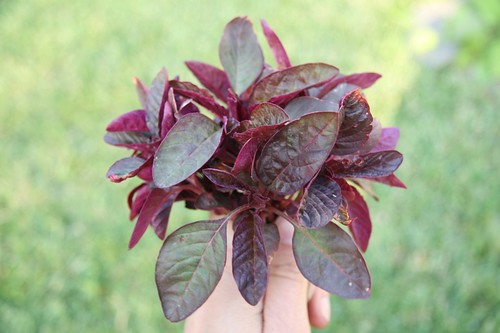
We a seemingly endless amount of weeding and thinning this weekend which gave us a nice amount of amaranth, pursulane, chinese mustard and micro-greens to have for salads. A small reward for all the time spent on our knees.

Scott also mowed our lawn and used the grass clipping in our newest experiment in the broccoli/cauliflower bed. We read a great article in Mother Earth News this weekend that explored the different types of organic fertilizer on the market. As you know, fertilizers must be labeled by their Nitrogen, Phosphorous and Potassium (N-P-K) levels. Being that nitrogen is a likely deficient in many soils, the author compared the fertilizers based on their per pound of nitrogen. She compares 17 different store bought organic fertilizers, the cheapest being SoyBean Meal (7-2-1) at $4/lb of nitrogen and the most expensive being TerraCycle Plant Food (.03-.002-.02) at a whopping $16,987/lb of nitrogen.
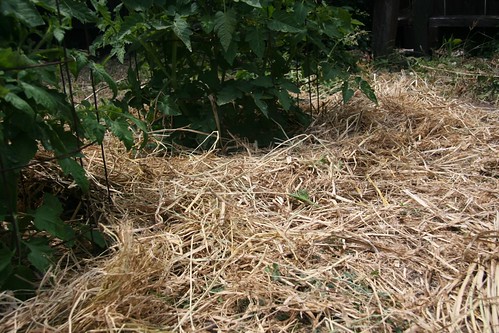
Or she says, you can just use ordinary grass clippings which contain anywhere from 2% – 5% of nitrogen. In most areas you can work in about half an inch into your soil, or put a 1-2 inch layer as a mulch on your garden bed and that will provide all the nutrients most crops need for a full season of growth! Not only will it provide nutrients, but the grass clippings as a mulch act as a good weed prevention and as a moisture retainer.
Usually we just put our grass clippings into the compost pile and let them compost. Doing that dilutes the nitrogen power down to about 1%, but the benefit of compost is that it departs its nutrients into the soil over a matter of years rather than in just one growing season.
Either way, obviously, is beneficial. And obviously much, much cheaper than buying organic fertilizer, wouldn’t you say? I don’t know, free vs. $16,987, you make the call.





Cool! Never thought of that. I just do the grasscycling where I leave the grass on our lawn and it decomposes or, theoretically does, if you cut it every week instead of every month.
I really like the grass garden mulch idea. I’ve been tossing mine into the compost bin. Didn’t realize it would be so beneficial to the garden.
I have a question for you..
I’ve got a packet of Amaranth seeds that I was planning to plant this year. Reading about the amaranth coming up everywhere in your garden has made me delay a little.
Would you plant it again if you had the chance, or do you think it is too invasive?
Hi Sarah, we would definately do it again, but at the end of the growing cycle, when it forms those beautiful golden seed heads we should have cut those off and thrown those in the garbage or better yet harvested them for grain. We made the mistake of putting them in the compst pile.
Greenbean, I heard leaving grass clippings behind as you mow is a great idea too.
Be careful using just any grass clippings or compost(commercially made), as most clippings come from yards that do not object to using weedkillers and the like.
The night crawlers on my property love the clippings. I collect every other cutting for compost and leave the next for the worms (some are almost a foot long) they sure leave a lot of castings some of which I collect for my garden. They have about 1.5% N content.
Thank you for mentioning us on your Web site. We’re glad you enjoy Mother Earth News.
Loved the post on organic fertilizers. Glad our article was helpful.
Laura Evers
Mother Earth News
You know, I was thinking of simply side dressing my corn bed with grass clippings since corn is a nitrogen hog. I was told to side dress with urea. I may try this.
FYI, another good free nitrogen source are coffee grounds from Starbucks. I mixed them into the top 6 inches a month before I planted.
Thanks!
My fellow on Facebook shared this link with me and I’m not dissapointed at all that I came here.
I would rather pay the “free” price.
Hi, I’ve been contacting grass-cutting services for the last year, using the grass clippings for my compost; only recently have I also decided to try using the clippings as mulch & see what occurs. Glad to hear that it has been suggested by someone else; I’ll keep you posted as to its efficacy too.
Umm… not to put a damper on this but… dried out grass clippings lose most of their nitrogen content vs fresh grass clippings that are properly composted. That would be why dried grass clippings are considered a carbon source for composting, while fresh clippings are considered a nitrogen. (rough range of the difference is C:N ratio being 15:1 to 25:1.)
Also coffee grounds are a nice free bonus to add to compost as they are a C:N of 25:1.. only about .5% nitrogen that is going to be readily available and in total (once composted) they offer about 2% nitrogen. Just make sure you don’t mix in too much that isn’t composted as it will actually be able to heat up the soil. Top dressing you don’t want to add more than an inch as it can actually repel water.
The reason behind trying to get a hot composting ratio of 30:1 (C:N) is because that is the ideal mixture in which there is enough nitrogen to get the initial bacterial colonies going before the thermophilic colonies kick in… and enough carbon to both feed as well as capture escaping nitrogen. (The barnyard ammonia aroma is the scent of nitrogen fleeing your compost.)
Always good to look at charts as the C:N ratio of materials isn’t as simple as just “brown” and “green” which is why so many have troubles with it.
Too thick on grass clippings for mulch, and like with coffee grounds, it too can prevent water from reaching the soil. Some cover crops though can be grown in the location you intend on planting and then cut down in spring (leaving their roots in place). Then you just push them aside a bit to plant (as well quite a few are nitrogen fixing.. so by cover cropping you are keeping the nitrogen contained vs leeching away from precipitation).
I know this is an old post but I wanted to make a couple comments.
Green grass clippings are a wonderful mulch and one I used in the massive heat of North Texas for years. The soil stayed cooler and kept it from drying out in the intense hot sun. Because of that sun, it would break down quickly, and sometimes I didnt have near the amount on my beds as I wish I had.
I always kept it a few inches from my plants stems so its heating up wouldnt hurt my tender plants but once the nitrogen had released, I pushed it up close so weeds didnt pop up.
At one time, I wasnt so concerned about gardening organically, though I have always leaned that way (was reading Mother Earth in the 70s-& my s/o actually printed for them in their very first incarnation in Ohio). Anyways, I would go to town on Saturday and pick up fresh mowed & bagged grass on the curb and bring it home & dump it all over my garden.. It was a large & sandy plot and this was a great deal.. The grass wasnt organic Im quite sure judging from the yards I got them from, but my garden loved it..
Much of it had the tilth ala Ruth Stout garden thanks to doing this.. which was something of a feat there in the Texas heat.. Heaven!
Btw.. if you’re not familiar with Ruth Stout.. look her up..good stuff.
Enjoyed reading this post! 😀
A little bit (very few ounces) of Sea salt about every 4 years and well watered in will give your garden all the micro-minerals your plants need. They sure will taste much better, and be very healthy plants, the bugs will not like them. Bugs are natures clean-up crews to get rid of unhealthy plants. The weeds you try to get rid of serve as trap crops for bugs.
My husband doesn’t like composting grass or using it as mulch because we have a fair amount of weeds in our grass. Should that be a concern? Will new weeds grow in my garden if I use their clippings in the mulch?!